
When I describe Simplex to people, I often get a reasonable question: "How is this different from LangChain? Or AutoGen? Or any of the other agent frameworks?"
It's a fair question. The AI agent space is crowded. Every major tech company has released an agent SDK. Startups have raised billions. The landscape is noisy, confusing, and filled with marketing claims that blur meaningful distinctions.
So I did the research. I surveyed the competitive landscape—not to prove Simplex is "better," but to understand where it sits and whether it genuinely offers something different. This post is that analysis, presented as objectively as I can manage while acknowledging my obvious bias.
The short answer: Simplex is genuinely different. Not incrementally better at the same thing, but architecturally distinct in ways that matter. Whether that difference is valuable depends on what you're trying to build.
The Landscape in 2026
Before comparing specific projects, let's acknowledge where we are. The industry has recognized that something is broken with current approaches:
- The Conversation notes that "AI agents arrived in 2025... challenges ahead in 2026"
- The New Stack asks: "Can the 50-Year-Old Actor Model Rescue Agentic AI?"
- Medium declares: "2025 Overpromised AI Agents. 2026 Demands Agentic Engineering"
- InfoQ observes: "AI Agents Become Execution Engines While Backends Retreat to Governance"
The consensus: current agent approaches are hitting walls. The question is what comes next.
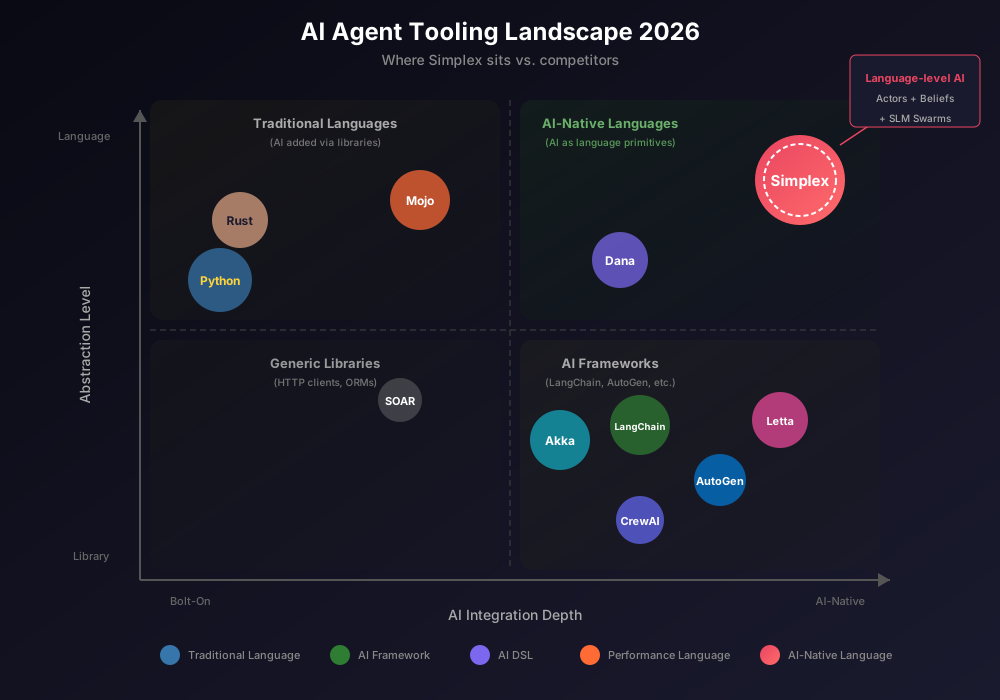
Competitor Analysis
Let me walk through the major approaches in the market, what they do well, and where they fall short compared to what Simplex is attempting.
Dana (AI Alliance) — The Closest in Ambition
Dana is the most similar project in stated goals. Released in June 2025 by the AI Alliance (a consortium including IBM, Meta, and others), it bills itself as "the world's first AI-powered programming language."
What Dana claims:
- Intent-driven development—describe what you want, the language handles implementation
- Agent-native with concurrency and knowledge grounding
- Neurosymbolic architecture for consistency (90%+ accuracy on hard problems)
- Transparency and debuggability
The reality:
- Dana uses
.nafiles but runs on a Python runtime—it's a DSL, not a new language - No actor model—concurrency is library-level
- No ownership semantics—standard Python garbage collection
- No distributed computing—single-machine focus
- No belief systems—"knowledge grounding" is RAG-style retrieval, not epistemics
- Industrial AI focus (manufacturing, maintenance)—not general-purpose
Verdict: Dana is a marketing-driven "language" that's really a Python DSL with good prompting. The neurosymbolic claims are interesting but the architecture is conventional. Documentation here.
Mojo (Modular) — Performance Focus
Mojo from Modular (founded by Chris Lattner, creator of Swift and LLVM) is a genuine new language. It's a Python superset targeting AI/ML performance.
What Mojo does well:
- Python superset with C++/Rust performance
- MLIR-based compilation (same foundation as LLVM)
- 35,000x faster than Python for matrix operations
- Targets GPUs/TPUs directly
- Memory safety without garbage collection
What Mojo lacks:
- No agent architecture—it's about compute performance, not agent cognition
- No actors—no message-passing, no supervision trees
- No memory/beliefs—no persistent state primitives for agents
- No distribution—single-node focus
- Closed-source compiler (as of October 2025)
Verdict: Mojo is excellent for AI/ML kernel performance. It's completely orthogonal to Simplex's goals—not a competitor so much as a potential compilation target. If you need fast matrix math, use Mojo. If you need cognitive agents, it offers nothing.
Letta (formerly MemGPT) — Memory Focus
Letta (evolved from the MemGPT research project at UC Berkeley) is the leader in persistent memory for AI agents.
What Letta does well:
- Persistent memory for LLM agents that survives across sessions
- Memory blocks (in-context) plus external memory (retrieval)
- Self-editing memory via LLM tool calls
- Agent File (.af) format for serializing stateful agents
- #1 on Terminal-Bench for model-agnostic coding agents
What Letta lacks:
- Python framework—not a language, so no compile-time guarantees
- No actors—no isolation, no supervision, no fault tolerance
- No belief systems—memory is not the same as beliefs (no truth categories, no confidence tracking, no rational revision)
- No distribution—agents are single-process
- LLM-dependent—memory management itself requires LLM calls
Verdict: Letta is the best memory abstraction in the Python ecosystem. But memory without epistemics is just a vector store with extra steps. And it's still a framework on Python, not a language with compile-time safety. MemGPT concepts here.
Akka Agentic Platform — Actor Model for AI
Akka represents the most architecturally sophisticated competition. Built on 15 years of battle-tested actor model infrastructure, they've pivoted to agentic AI with impressive results.
What Akka does well:
- Battle-tested actor model with isolation and message-passing
- Agents as actors with private state
- Memory component (fast, durable)
- 1B+ tokens/second throughput
- Enterprise-grade (99.9999% uptime)
- Horizontal scaling and distributed coordination
What Akka lacks:
- JVM framework—you write Scala/Java, not a purpose-built language
- No AI primitives—you wire up LLM calls yourself
- No belief systems—no epistemics, just state
- No SLM swarms—assumes external LLM APIs, not coordinated small models
- No ownership semantics—JVM garbage collection
- No content-addressed code—standard versioning
Verdict: Akka is the closest to Simplex in architecture (actors + AI agents). But it's infrastructure, not a language. You get the actor model but not AI-native primitives or cognitive architecture. Deep dive on Akka's approach here.
SOAR and ACT-R — Cognitive Architectures
SOAR and ACT-R represent 40+ years of cognitive architecture research. They're the academic gold standard for agent reasoning.
What they do well:
- Deep cognitive modeling with theoretical foundations
- Belief systems, reasoning, learning
- Production rules and memory systems
- Being integrated with LLMs in 2025 research
What they lack:
- Ancient implementations—C/C++/Lisp, not modern tooling
- No distributed computing—single-agent focus
- No modern AI integration—LLM support is bolted on
- Academic, not production—research tools, not deployment platforms
- No actor model—sequential processing
Verdict: Theoretically rich, practically limited. The cognitive science is valuable; the implementations are outdated. SOAR's ideas should inform modern systems; SOAR itself isn't one.
Python Agent Frameworks
The bulk of the market consists of Python libraries: LangChain, LangGraph, AutoGen, CrewAI, Semantic Kernel, and dozens more.
Common limitations:
- Libraries on Python, not languages—no compile-time type safety
- No ownership semantics—memory leaks, GC pauses
- No true distribution—async Python isn't distributed actors
- Memory is "add a vector store"—no epistemics
- No belief systems—no truth categories, no confidence
Verdict: Adequate for prototyping. Inadequate for production cognitive systems. The 2025 framework survey shows impressive capabilities, but they're all constrained by being libraries on Python.
Research Frameworks: DeepAgent and Similar
Research projects like DeepAgent (from Renmin University and Xiaohongshu) represent the academic cutting edge. DeepAgent features unified reasoning streams, brain-inspired memory folding, and dual-LLM architecture.
What they do well:
- Novel prompting patterns (memory folding, unified streams)
- Strong benchmark performance
- Academic rigor
What they lack:
- Research artifacts—designed for benchmarks, not production
- Python glue—orchestrating LLM API calls
- Context window workarounds—memory folding exists because LLMs have context limits
- No persistence—everything is forgotten after task completion
Verdict: Valuable research contributions, but solving problems at the wrong layer. Simplex's persistent memory makes memory folding unnecessary.
The Comparison Table
Here's a direct feature comparison:
| Capability | Simplex | Dana | Mojo | Letta | Akka | SOAR |
|---|---|---|---|---|---|---|
| New language with AI primitives | Yes | Python DSL | ML focus | Framework | Framework | Old |
| Actor model + supervision | Yes | No | No | No | Yes | No |
| Ownership semantics (no GC) | Yes | No | Yes | No | No | No |
| Persistent epistemically-grounded memory | Yes | No | No | Memory only | State only | Yes |
| BDI agents as syntax | Yes | No | No | No | No | Partial |
| SLM swarms (CHAI) | Yes | No | No | No | No | No |
| Swarm computing (spot instances) | Yes | No | No | No | Yes | No |
| Content-addressed code | Yes | No | No | No | No | No |
| Self-hosted compiler | Yes | No | No | N/A | N/A | No |
What Makes Simplex Architecturally Distinct
The table shows feature differences, but the deeper distinction is architectural. Simplex combines influences that no other project unifies:
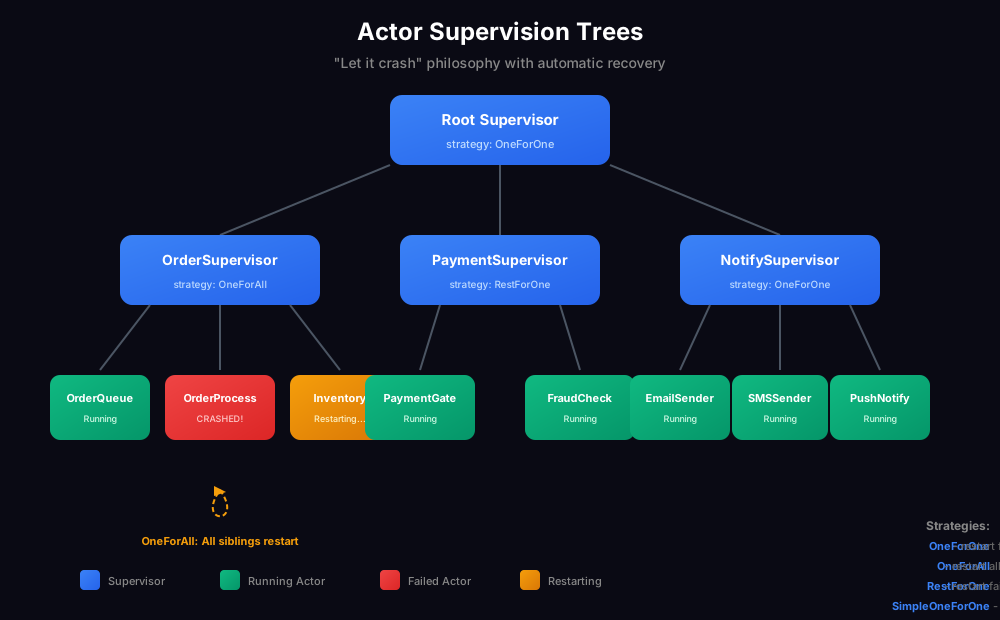
1. From Erlang: Fault-Tolerant Actors
Simplex uses the actor model with supervision trees. Actors are isolated, communicate via message-passing, and can fail without bringing down the system. This isn't novel—Erlang proved it decades ago, and Akka brought it to the JVM. But Simplex makes actors a language primitive, not a library abstraction.
actor Counter {
    var count: i64 = 0

    receive Increment {
        count += 1
    }

    receive GetCount -> i64 {
        count
    }
}

supervisor CounterSystem {
    strategy: OneForOne,
    max_restarts: 3,
    children: [child(Counter, restart: Always)]
}
2. From Rust: Ownership Without Garbage Collection
Simplex uses ownership semantics for deterministic memory management. No garbage collector means no GC pauses—critical for real-time AI workloads. Values have exactly one owner; borrowing is explicit; resources are freed deterministically.
This matters for AI because inference latency is critical. A GC pause during a user interaction is unacceptable. Simplex guarantees it won't happen.
3. From Unison: Content-Addressed Code
Functions in Simplex are identified by SHA-256 hash of their implementation. This eliminates version conflicts and enables perfect caching. When code migrates across a distributed swarm, the hash guarantees identical behavior.
4. From Cognitive Science: Belief Systems
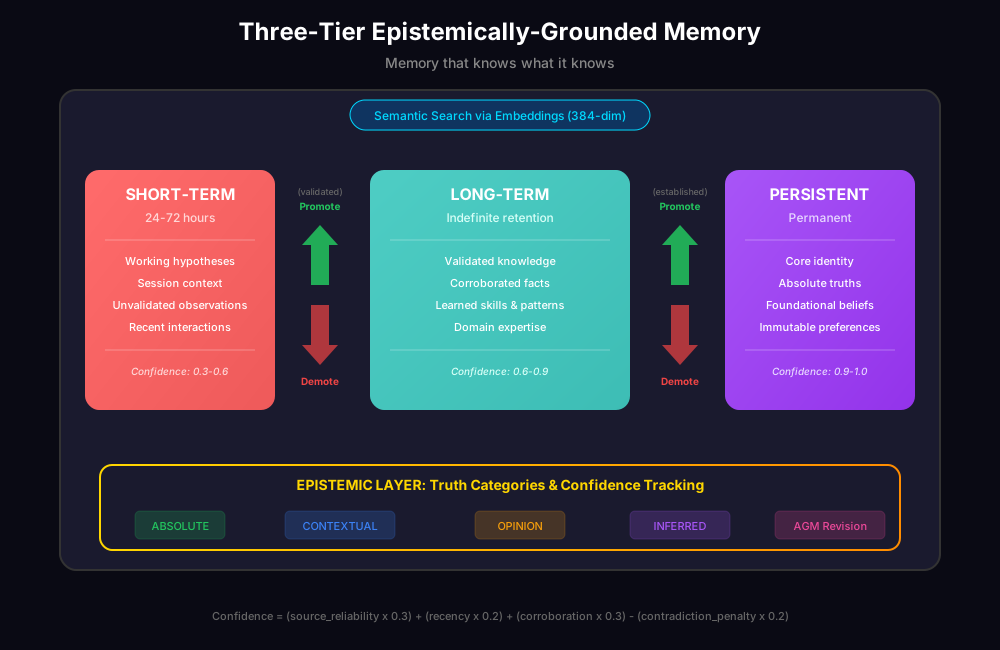
This is where Simplex diverges most sharply from competitors. Memory in Simplex isn't a vector store—it's an epistemically-grounded system with:
- Truth categories: ABSOLUTE (empirically verifiable), CONTEXTUAL (domain-specific), OPINION (unverifiable preferences), INFERRED (derived, provisional)
- Confidence tracking: Bayesian updates based on source reliability, recency, and corroboration
- Belief revision: AGM-style rational update when evidence contradicts existing beliefs
- Three-tier memory: Short-term (working hypotheses), long-term (validated knowledge), persistent (core identity)
No other system in the market treats epistemics as a first-class concern. Letta has memory. SOAR has beliefs. Simplex has both, unified at the language level.
5. From AI Research: SLM Swarms
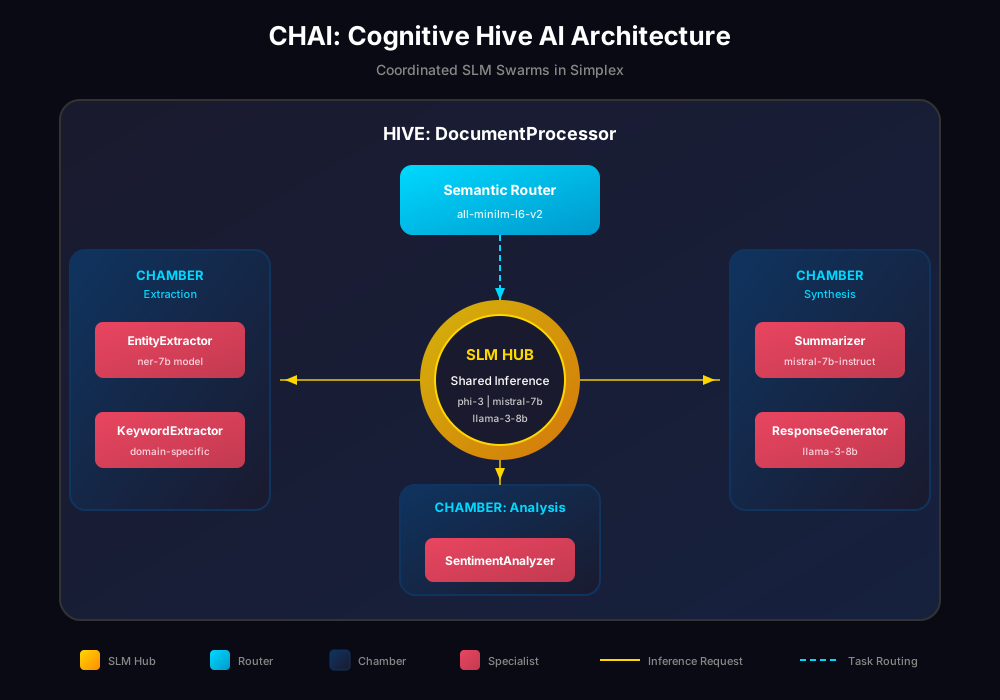
The CHAI (Cognitive Hive AI) architecture assumes coordinated small language models, not a single large model. Specialists focus on specific domains; hives coordinate their efforts; routers direct tasks to appropriate specialists.
specialist EntityExtractor {
    model: "ner-7b",
    domain: "named entity extraction",

    receive Extract(text: String) -> List<Entity> {
        let raw = infer("Extract entities from: {text}")
        parse_entities(raw)
    }
}

hive DocumentProcessor {
    specialists: [Summarizer, EntityExtractor, SentimentAnalyzer],
    router: SemanticRouter(embedding_model: "all-minilm-l6-v2"),
    strategy: OneForOne
}
This isn't just architecture—it's economic. NVIDIA has argued that small models are the future of agentic AI. Simplex is designed for that future.
6. From Distributed Systems: Swarm Computing
Simplex is designed for ephemeral cloud infrastructure—specifically spot instances. Actors checkpoint their state; work migrates transparently when nodes fail; the system treats node failure as normal, not exceptional.
The target runtime is a $0.0013/hour nano instance, not an expensive GPU server. This inverts the cost model for AI deployment.
The Fundamental Difference
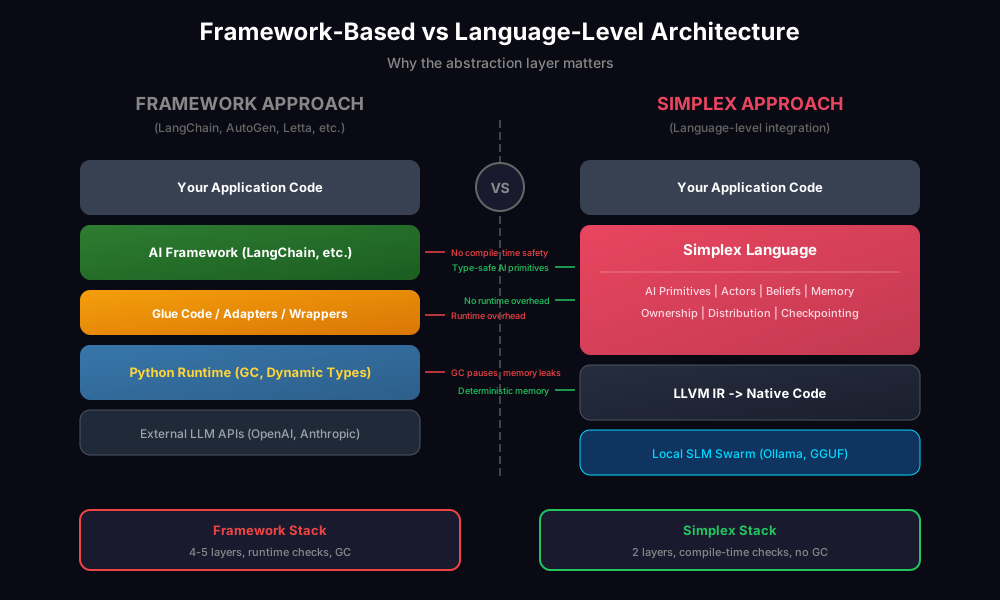
Every other system in this analysis is one of:
- A library/framework on an existing language (LangChain, Letta, Akka)
- A language focused on performance, not agents (Mojo)
- A DSL pretending to be a language (Dana)
- An academic system not designed for production (SOAR, ACT-R)
Simplex is none of these. It's a purpose-built language where:
- AI operations are syntax, not library calls
- Actors are the fundamental unit of computation
- Memory is epistemically grounded
- Distribution is transparent
- The compiler is self-hosted
This isn't incremental improvement. It's a different category of thing.
The Honest Caveats
I've made strong claims. Here are the honest limitations:
Simplex is Still Being Built
Phases 1-21 are complete. This includes the self-hosted compiler (verified: Stage2 compiles Stage3 identically), the complete toolchain written in pure Simplex (sxc compiler, spx package manager, sxdoc documentation generator, cursus bytecode VM, and sxlsp language server), and full core language features (Result<T,E> with ? operator, generic monomorphization, trait bounds, associated types, const generics, and multi-file modules with automatic dependency resolution).
We're now in phases 22+ completing advanced async features and the Mnemonic Hive language extensions. The language works. The toolchain works. We're refining, not bootstrapping. But it's not yet packaged for public consumption—no installer, no tutorial, no ecosystem.
The Ecosystem Doesn't Exist
Python has 300,000+ AI/ML packages. Simplex has... the standard library we're building. Ecosystem matters, and Simplex has none yet.
Novel Doesn't Mean Adopted
Being architecturally distinct doesn't automatically mean Simplex will be adopted. Novel languages fail all the time. The market might not want what Simplex offers, or might not recognize that it needs it yet. That said, the self-hosted compiler compiling itself is a strong signal that this isn't vaporware.
Akka is Battle-Tested
If you need production-ready actor-based AI infrastructure with enterprise support today, Akka is the answer. Fifteen years of hardening builds confidence. Simplex has a working self-hosted compiler and toolchain—but not fifteen years of production deployments. We're building; they're proven.
Conclusion: Different, Not Better
Is Simplex really different? Yes. The combination of language-level AI primitives, actors, ownership, belief systems, and SLM swarms is unique. No other project unifies these concerns.
Is Simplex better? That depends on what you're building and when you need it.
- If you need something today with ecosystem: Use Python frameworks or Akka
- If you need performance: Use Mojo for kernels, Akka for infrastructure
- If you need persistent memory: Letta is the current leader
- If you want to build with Simplex now: The language and toolchain work—we're using them daily. Reach out.
- If you're building production cognitive systems: Simplex is attempting something no one else is, and we're further along than you might think
The industry is recognizing that current approaches have fundamental limitations. Akka pivoted to agentic AI. The AI Alliance created Dana. Letta focuses on memory. Everyone is moving toward the problems Simplex is designed to solve.
The question isn't whether these problems matter—they clearly do. The question is whether a purpose-built language is the right solution, or whether frameworks on existing languages will eventually catch up.
I'm betting on the language. But then, I would say that.
Links and Resources
Competitors Discussed
- Dana (AI Alliance) — Agent-native programming language
- Mojo (Modular) — High-performance Python superset
- Letta — Persistent memory for AI agents
- Akka Agentic Platform — Enterprise actor-based AI
- SOAR — Cognitive architecture
Python Agent Frameworks
Industry Analysis
- AI Agents in 2025: What Happened — The Conversation
- Can the Actor Model Rescue Agentic AI? — The New Stack
- Top 9 AI Agent Frameworks — Shakudo
- Agentic AI Frameworks for Enterprise Scale — Akka
Simplex Documentation
This analysis was conducted in January 2026. The AI agent landscape moves quickly; some details may be outdated by the time you read this.